Understanding Belgium’s Education System
A practical guide to Belgium’s education system, explaining the differences between its Dutch-, French- and German-speaking communities, school enrolment, preschool, primary and secondary education, public and private schools, international qualifications, special educational needs, homeschooling, and language support for expat families.
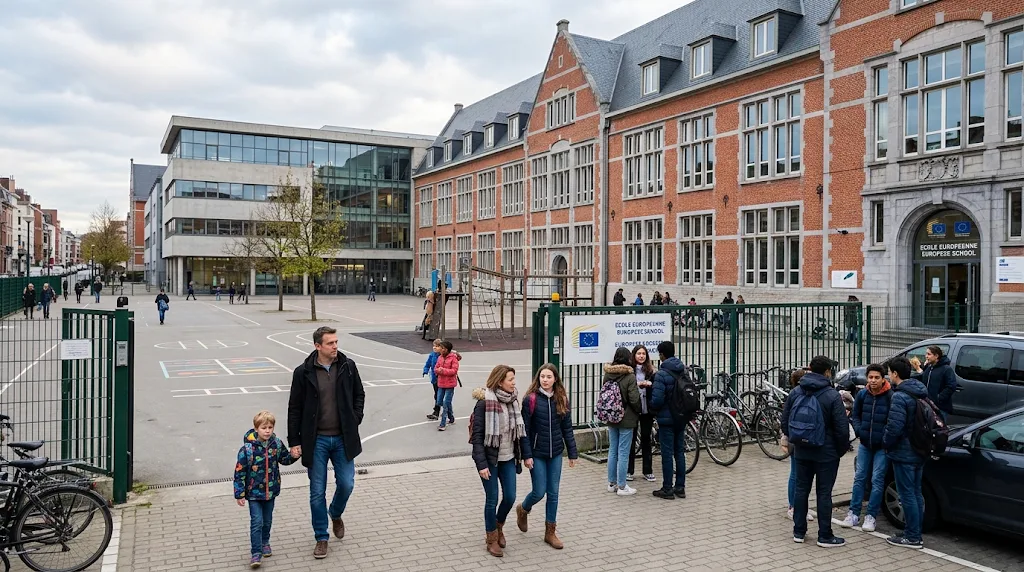
For families who have recently moved to Belgium, getting to grips with the country’s education system may initially feel complicated. This guide explains how schooling is organised across the three language communities and helps you understand the options available when choosing the right education for your child.
Belgium offers a wide selection of educational approaches and school levels. However, the rules and arrangements differ across the Dutch-speaking, French-speaking and German-speaking communities, which can make the system difficult to navigate at first. Most Belgian children attend free public schools or privately managed schools that receive government subsidies, including religious institutions. Fee-paying private education is also available, with international schools being particularly popular among expatriate families.
Fortunately, the variety of schools and programmes means that families can find an option suited to their children’s circumstances. Whether your child is beginning their education or preparing for internationally recognised secondary-school qualifications, there are several pathways to consider.
This guide introduces the Belgian education system and covers the following topics:
How education is organised in Belgium
Belgium has three separate language communities, each with responsibility for its own education system:
- Dutch-speaking community
- French-speaking community
- German-speaking community
Each community establishes its own rules for education and school admissions.
Although arrangements vary in certain respects, compulsory education in Belgium generally covers children from six to 18 years old. It is organised into two main stages:
- Primary education: Ages 6–12.
- Secondary education: Ages 12–18.
Before compulsory schooling, children aged two and a half and above can also attend publicly funded pre-primary education facilities.
European School of Brussels
Main categories of schools in Belgium
Each region has three principal types of educational institutions, alongside fee-paying private schools:
- Community schools: Known as gemeenschapsonderwijs or GO! in Dutch, and réseau de la Communauté française in French. These are state-run schools that maintain a religiously neutral approach to education.
- Subsidised public schools: Referred to as officieel gesubsidieerd onderwijs in Dutch and réseau officiel subventionné in French. These institutions are organised by local authorities, including municipalities.
- Subsidised private schools: Called vrij gesubsidieerd onderwijs in Dutch and réseau libre subventionné in French. This category includes schools with religious affiliations.
- Fee-paying private schools: These include international schools, Montessori institutions and other privately funded educational establishments.
Registering your child at a Belgian school
Every child living in Belgium must be enrolled in an educational institution within 60 days of being registered with their municipality.
The documents generally required for school registration include:
- Proof of identity.
- A Belgian residence visa, where applicable.
- Evidence of vaccination in Belgium.
- Proof of residential address.
- Previous school records or academic reports, if available.
Children who do not have official residence documents are also legally entitled to enrol in a school.
Belgian schools do not generally operate according to fixed catchment areas. This means parents can choose a school regardless of where they live. However, a school close to your home may already have reached its enrolment capacity.
Admission arrangements differ between Dutch-language and French-language public schools. They may also depend on the time of year your family moves to Belgium. For the most accurate guidance, consult the relevant education department for the Dutch-speaking, French-speaking or German-speaking community.
Some families may prefer an international curriculum that provides qualifications recognised in other countries. International schools are a popular choice among expatriates, particularly for families relocating through an employer that may contribute towards school fees.
Whichever type of school you select, Belgium is recognised for its strong educational standards. Reports published annually by the Organisation for Economic Co-operation and Development (OECD) have placed the country's education system among the world's top 10. Belgian pupils achieve results above the OECD average in science, mathematics and reading. Belgium also ranks among the 40 OECD countries with the highest levels of investment in education.
Early childhood and preschool learning in Belgium
Preschool attendance is not compulsory, but it can offer several advantages for young children and their parents.
Because these facilities receive public funding, nurseries and preschools can provide childcare free of charge for working families. Although formal academic lessons are limited at this stage, children take part in play-based activities that help them develop the social and learning skills needed for primary school.
More than 90% of children in Belgium attend preschool. However, popular institutions may have limited places, so it is worth looking into availability early.
Nurseries generally accept babies and toddlers until they reach two and a half years of age. From that point, children can attend kindergarten, known as kleuteronderwijs in Dutch or enseignement maternelle in French, until they are old enough to start primary school.
Many kindergartens are connected to nearby primary schools. This arrangement can make the move from early childhood education to formal schooling easier for children.
Primary schooling in Belgium
Understanding the primary education system
Primary education, called lager onderwijs in Dutch and enseignement primaire in French, is compulsory for children between six and 12 years old.
The education departments within the respective communities are responsible for supervising school requirements and setting the curriculum for their areas.
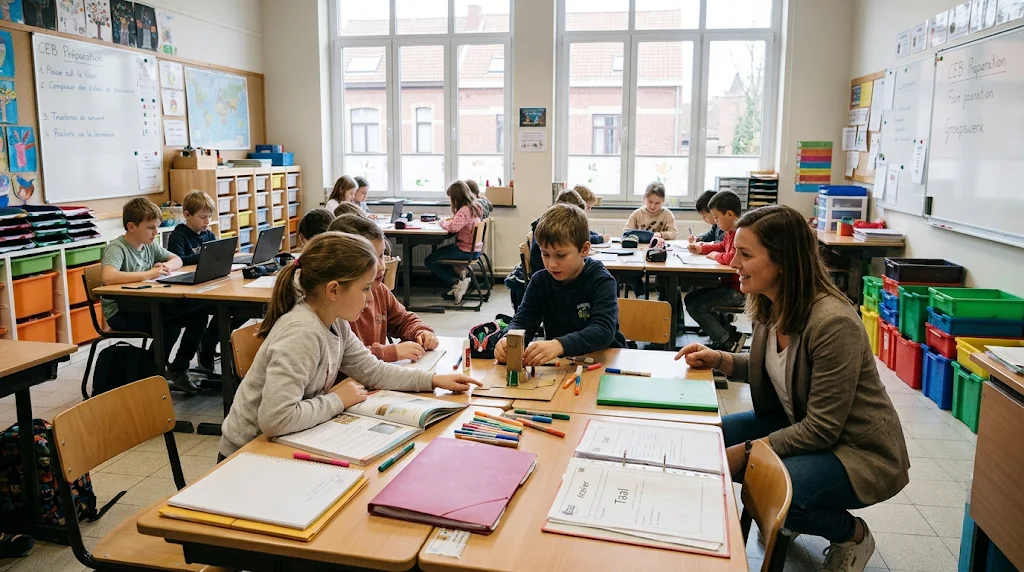
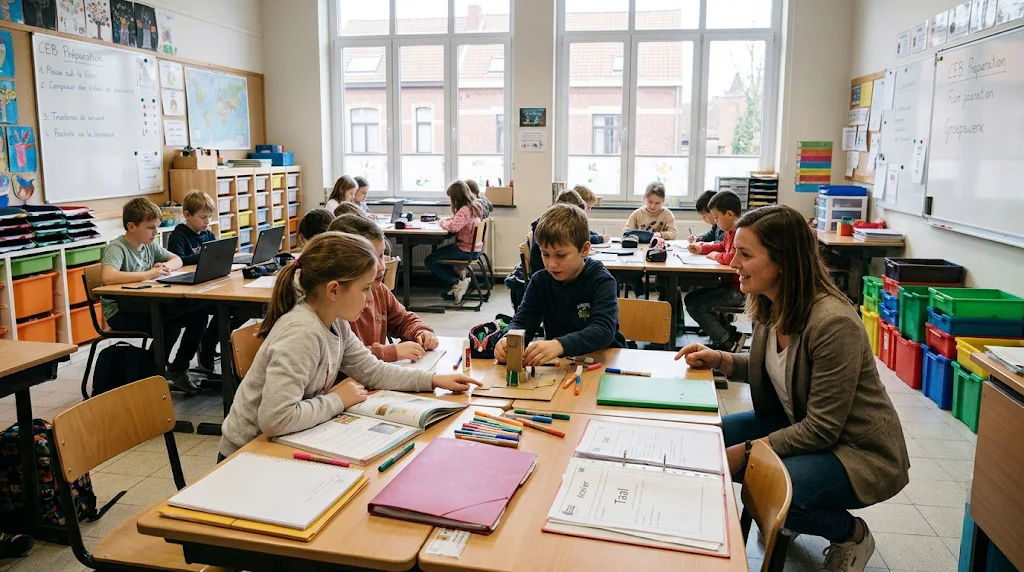
Primary school pupils collaborating on a classroom task
Belgian schools place importance on ensuring that children progress at an appropriate pace. Pupils are assessed at different stages, from preschool through to secondary education, to establish whether they are ready to advance.
Repeating a school year is relatively common when a child needs more time to develop the required skills. It is not generally viewed as something that should carry a negative social stigma.
After finishing primary school, pupils receive a primary education certificate. This qualification is known as the Certificat d’Etudes de Base (CEB) in French or the Getuigschrift van Lager Onderwijs in Dutch. It is an important document when progressing to secondary education.
Public primary schools in Belgium
Public primary education is free throughout Belgium. Nevertheless, families may need to pay for certain items, such as educational materials and school excursions. Some learning resources may qualify for financial subsidies.
The teaching programme is generally traditional in structure. Mornings are commonly dedicated to core subjects such as reading, writing and mathematics, while afternoons may include music, history and other areas of study. In many schools, Wednesday afternoons are not scheduled for classes.
Foreign-language learning is another important part of primary education. During the final years, pupils are usually required to study another national language:
- Children in the French-speaking community generally learn Dutch or German.
- Pupils in the Dutch-speaking community generally study French.
Families choosing a local school should also be aware of language requirements for primary admission. Children may need to have completed a specified number of half-days at a Dutch- or French-language preschool before enrolling. If they have not met this attendance requirement, they may need to take a basic language assessment to demonstrate their ability in the language of instruction.
Private primary schools in Belgium
Parents who prefer private education, an international curriculum or a different teaching philosophy can choose from several types of primary schools.
The main options include:
- Alternative-method and Montessori schools: These institutions use different educational approaches, encouraging creativity, independent thinking and the overall development of the child.
- International schools: Families can select from British, American, European and other international curricula.
- Religious schools: These include institutions such as Catholic and Jewish schools. Many receive government subsidies.
Secondary schooling in Belgium
An introduction to secondary education
Secondary education in Belgium is known as secundair onderwijs in Dutch and enseignement secondaire in French. It is compulsory for young people between the ages of 12 and 18.
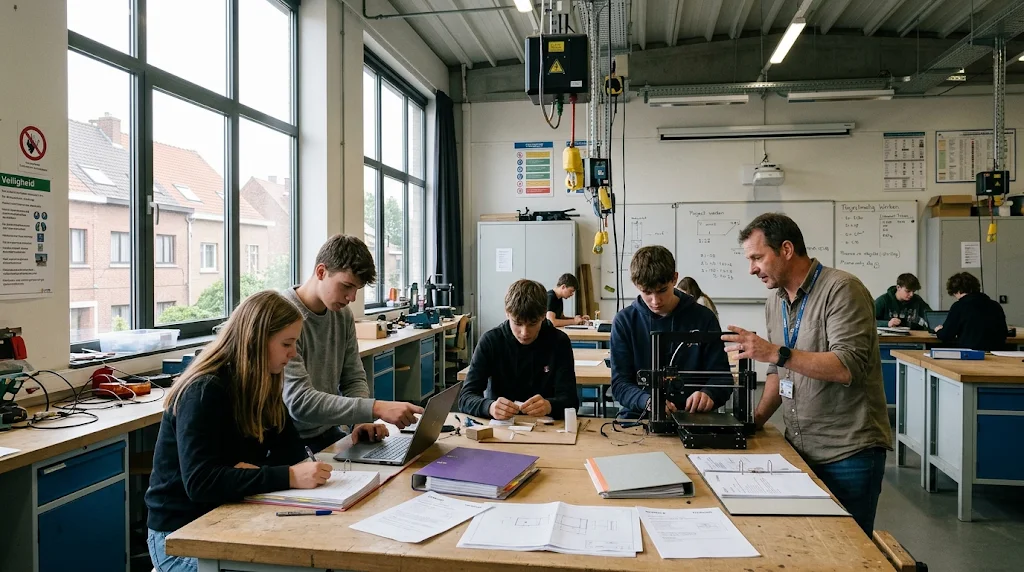
From the age of 16, students may choose a part-time educational route that combines learning with vocational or technical training.
Public secondary schools in Belgium
State secondary schools are free for all pupils, although parents may be asked to contribute towards expenses such as textbooks.
At the beginning of secondary education, students follow a broad curriculum. As they progress into higher years, also known as cycles, they gain more opportunities to select subjects and focus on particular areas.
During the final cycle, between ages 16 and 18, students can also combine part-time education with vocational training.
Secondary school pupils
As students begin choosing a specialisation, their studies generally follow one of four pathways:
- General education: Designed mainly to prepare students for higher education. It places emphasis on theoretical learning and a broad foundation of knowledge.
- Technical education: Combines elements of general education with more practical and technical instruction. It prepares students either to enter employment in a particular profession or to continue studying.
- Vocational education: Concentrates heavily on practical skills and prepares learners to enter a specific occupation after completing their studies. Students may also undertake one or more additional years, referred to as the fourth degree.
- Arts education: Structured in a similar way to technical education, but students choose options focused on artistic and other non-technical subjects. Depending on their chosen subjects, graduates can continue at a specialised institution, such as an art college, or pursue studies at a university or college.
Some secondary schools concentrate on just one of these pathways, while others provide several different sections or streams within the same institution.
Private secondary schools in Belgium
Private secondary institutions provide a variety of teaching approaches. International schools, in particular, allow students to follow overseas curricula and work towards qualifications that are recognised internationally.
Available options include:
- International schools: These institutions follow educational systems from countries and regions such as the UK, the United States, the Nordic countries and Europe. Their teaching methods, curricula and qualifications depend on the system they adopt. For example, pupils at British schools may work towards GCSEs and A-levels. Schools offering the International Baccalaureate (IB), including Agnes School and BEPS International School, are also popular with international families who want their children to have a smoother route into higher education around the world.
- Subsidised private schools: This group includes religious institutions and represents a substantial part of Belgium's secondary education sector, particularly in Flanders.
- Montessori schools: Only a small number provide secondary education. One example is the International Montessori School in Tervuren, where pupils move to the IB programme from the age of 11.
- Steiner schools: These institutions follow a human-centred educational philosophy that combines intellectual learning with practical and artistic development. At secondary level, particular attention is given to developing critical reasoning.
- Other independent schools: Some offer alternative educational models. Sudbury School in Ghent, for instance, follows an American approach in which children take responsibility for directing their own education. French-speaking Le Labo focuses on sports education.
International school tuition fees may involve making payments across national borders. Families and students can reduce the cost of these transactions by using services such as Wise to transfer money internationally.
Unlike banks that may apply an additional margin to their exchange rates, Wise uses the mid-market exchange rate and charges a small, clearly stated fee.
Completing secondary education in Belgium
Belgium's approach to examinations and academic assessment may not be particularly popular with students. Testing takes place throughout secondary school, and the assessment process is relatively rigorous.
Students who successfully complete secondary education receive one of the following qualifications:
- Diploma van Secundair Onderwijs: The Dutch-language secondary education diploma.
- Certificat d’Enseignement secondaire supérieur général, technique ou artistique (CESS): The French-language certificate for general, technical or arts-based upper secondary education.
These qualifications allow students to apply for higher education.
Students following vocational education should be aware that they may need to complete an additional year of study to obtain the relevant certificate. For this reason, it is important to consider the available specialisations carefully, particularly if the intention is to continue into higher education.
International and alternative schools may award different qualifications when students graduate. These include British A-levels and the International Baccalaureate.
The International Baccalaureate in Belgium
The International Baccalaureate is a globally recognised educational programme accepted by higher education institutions in many countries.
A number of Belgian primary and secondary schools offer the IB curriculum.
Educational assistance for children with special needs in Belgium
Responsibility for supporting children with special educational needs (SEN) rests with the education department of the relevant language community.
Belgium's approach to special needs education is based on inclusion and equal access to learning. Wherever possible, children with additional needs are supported within mainstream schools. Many institutions employ permanent staff members who have specialist training in special needs education.
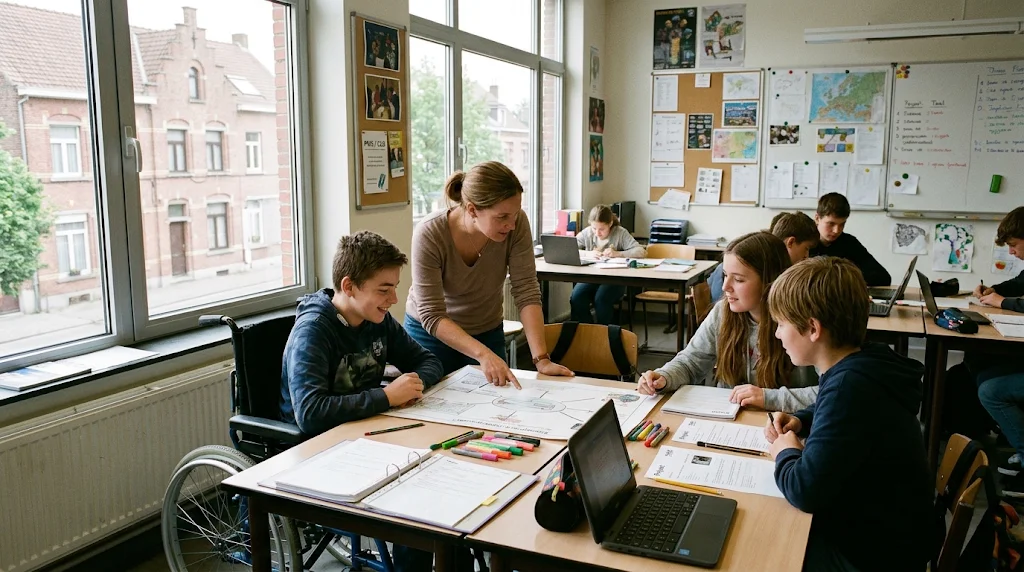
If attending a mainstream school is not suitable for a child, specialist educational institutions are also available. These schools accept children from preschool age up to 21 years old. Some focus on supporting pupils with physical disabilities, while others provide education for children with behavioural difficulties.
Student with special educational needs using a wheelchair
Admission to a specialist school is available throughout the year, but an assessment must first be completed to identify the most appropriate educational setting for the child.
The assessment may be arranged through:
- Centre psycho-médico-social (PMS): The French-language service in Liège.
- Centrum voor Leerlingenbegeleiding (VCLB): The Dutch-language pupil guidance service.
- Community Help Service (CHS): An alternative where assessment tests can be conducted in English.
Parents can obtain information about specialist schools in their area from the local town hall, known as Stadhuis in Dutch or Maison communale in French.
The individual education ministries also publish lists of special needs schools on their official websites.
Moving your child to another school in Belgium
Securing a place at a Belgian school can sometimes be challenging. As a result, transferring your child to a different institution during the academic year may not be straightforward.
Both public and private schools may operate waiting lists. In some cases, families begin the admissions process as much as two years in advance to improve their chances of securing a place at their preferred school.
Public school registration periods are also limited to particular times of the year, commonly December or January. These admission schedules can make a mid-year transfer more difficult.
International and other private schools may follow different admission arrangements and could accept applications at various points during the year. It is therefore best to contact the school directly to confirm its enrolment policy.
Home education in Belgium
Some expatriate parents choose to educate their children at home because of differences between educational curricula or the cost of international schools.
Homeschooling is permitted in Belgium, but families must follow specific educational requirements established by the language community in which they live. Children receiving home education are also required to complete annual assessments.
The number of children learning at home or receiving education from private tutors in Belgium has been increasing. A study by Agodi found that, in Flanders, the number of secondary-school-age children being homeschooled grew from approximately 100 to more than 1,000 between 2000 and 2014.
However, homeschooling is subject to strict rules. Parents who do not comply with the requirements may face sanctions.
If you decide to educate your child at home, you must inform the education department responsible for your language community. Parents are also required to sign a declaration confirming their commitment to the United Nations Convention on the Rights of the Child. This requirement has attracted controversy in the past.
Learning and academic assistance for expatriate children in Belgium
Because Belgium has several official languages, language education plays an important role in the public school system.
Financial support is available to help children who do not speak the main language used for teaching. The type and level of assistance can differ between schools, so parents should ask each institution what language-learning support it provides.
Some schools run language immersion programmes, while many also organise activities outside normal school hours. These may include homework clubs and additional educational assistance.
Parents can also consider private language lessons to give their children further support. Moienapp's guide to Finding Language Courses in Belgium: Dutch, French and German provides more information about the private language-learning options available.
Summer camps can offer another useful opportunity for children to meet others, become familiar with their surroundings and practise a new language.
Some international schools organise their own holiday programmes. There are also courses dedicated to particular languages, including CERAN's Intensive French Program for Juniors and Teens.
Helpful education links and information
The following organisations and websites provide further information about education in Belgium:
- Enseignement: French-speaking community's education department.
- Onderwijs: Flemish education department.
- Belgium.be: Official Belgian government portal for public information and services.