Understanding Italian Culture and Social Etiquette
Discover the customs and social expectations that shape everyday life in Italy, from greetings, communication, and dining manners to relationships, celebrations, and business culture. Learn practical etiquette tips to help you adapt, build connections, and feel more at home in Italian society.
From navigating professional relationships to building friendships, discover how to avoid uncomfortable situations and settle into everyday life in Italy.
Italians are often known for their passionate personalities, expressive communication, and distinctive social customs. Some of their traditions and expectations may differ from those in other European countries. So, how can you adjust to Italian culture and avoid standing out as a tourist after relocating?
This guide explores what you should know about Italian etiquette, including greetings, conversations, dating, celebrations, and everyday interactions.
Italian Society and Cultural Identity
Italy became a unified nation-state in 1861, but its cultural roots stretch back to Ancient Rome. For centuries, the country has been recognised for its contributions to art, architecture, and food. It is also home to the world's oldest surviving university and bank.
The country is made up of 20 regions, including the islands of Sicily and Sardinia. Each region has its own distinctive traditions and cultural identity, all of which contribute to what is recognised as Italian culture.
More than 90% of Italy's population speaks Italian as their native language, although numerous regional dialects are also spoken. Other first languages commonly found in the country include German, French, Albanian, Romanian, Arabic, and Greek.
According to the 2021 English Proficiency Index, Italy ranked 35th, indicating that English is less widely spoken there than in many other European countries.
The 2021 Eurobarometer survey reported the following religious and non-religious breakdown of Italy's population:
- Roman Catholic: 79.2%
- Atheist or agnostic: 11.6%
- Other Christian denominations: 5.2%
- Muslim: 1%
Italy is also home to Hindu, Buddhist, Sikh, and Jewish communities.
Income inequality remains a significant issue in the country. Approximately 7% of households experience extreme poverty, with the situation particularly serious in southern Italy. This economic divide is also reflected in the fact that only slightly more than half of Italians consider themselves middle class.
Traditional attitudes towards family life and religion remain relatively strong among many Italians. Politically, both left-wing and right-wing parties continue to attract considerable support.
Unfortunately, discrimination and racism are still present in Italian society. The Roma community is among the groups that experience significant marginalisation. Around 40% of Roma people reported experiencing harassment motivated by hatred during the previous year.
Anyone who experiences or witnesses racial discrimination in Italy can contact the National Office Against Racial Discrimination (Ufficio Nazionale Antidiscriminazioni Razziali – UNAR). Alternatively, they can call its free helpline on 800 90 10 10.
Gender Expectations and Equality in Italy
Italy still faces challenges in achieving gender equality, as reflected in several national and international statistics.
In the 2022 Gender Equality Index, Italy ranked 14th among European Union (EU) countries, scoring 65 out of 100. Women account for 42.6% of the country's workforce, a figure slightly below the averages recorded by both the EU and the Organisation for Economic Co-operation and Development (OECD).
The World Economic Forum's 2022 Global Gender Gap Report placed Italy 63rd worldwide and 25th in Europe.
Over the past five decades, Italy has made considerable progress in advancing women's rights. Although gender equality was recognised in the country's 1948 Constitution, legislation establishing the right to abortion and divorce was not introduced until the 1970s.
Women now enjoy greater freedom and opportunities than in previous generations. Nevertheless, some areas of Italian society remain dominated by men, with traditional expectations continuing to influence employment and family relationships. These attitudes are more common in the southern parts of the country.
A 2018 study also found that nearly half of women in Italy had experienced some form of sexual harassment.
If you or someone you know feels at risk of gender-based violence, you can contact Italy's free anti-violence helpline on 1522. The service is available 24 hours a day, seven days a week, in Italian, English, French, Spanish, and Arabic.
LGBTQIA+ rights have also progressed in Italy over the past 20 years. However, discrimination remains a concern, with 40% of people in the community reporting that they experience it regularly.
The United Nations High Commissioner for Refugees (UNHCR) provides a directory of social, legal, and psychological support services for LGBTQIA+ people living in Italy.
How to Greet and Introduce Yourself in Italy
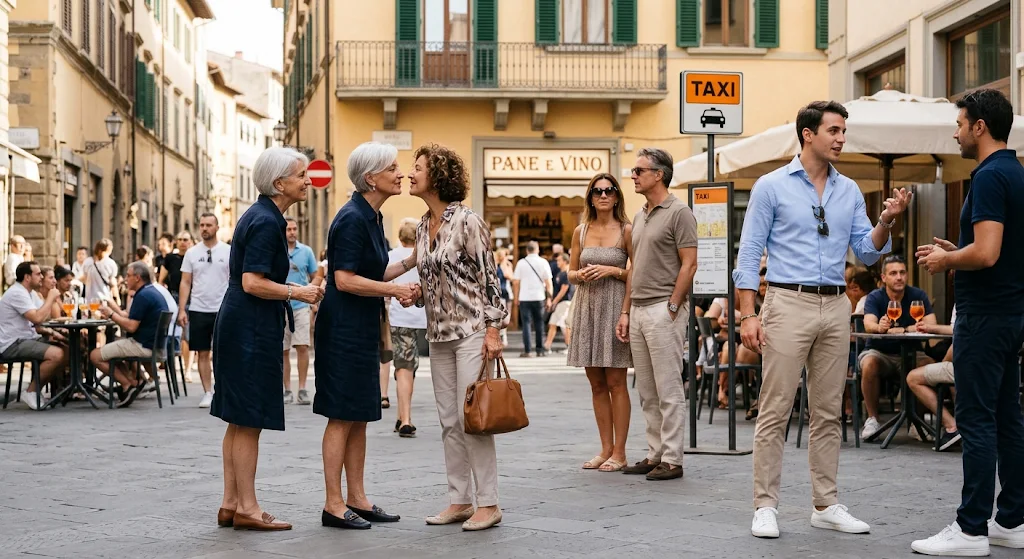
One of the most recognisable Italian greetings is the cheek kiss. When greeting friends and relatives, people commonly exchange two light air kisses, one on each cheek.
For more formal encounters, such as professional meetings or introductions to people you do not know well, a handshake is generally more appropriate.
The words you use also depend on the situation:
- Ciao: An informal way to say hello or goodbye.
- Salve: A polite greeting, particularly when you are unsure how formal to be.
- Arrivederci: A common way to say goodbye, including in more formal situations.
- Buongiorno: Good morning, suitable for formal greetings or when addressing older people.
- Buonasera: Good evening, also appropriate in more formal settings.
- Molto lieto: A polite expression meaning pleased to meet you.
Although younger Italians tend to be more relaxed about greetings, using respectful and formal language when speaking to elderly relatives is still common, even during family gatherings.
Using someone's first name is perfectly acceptable when speaking to friends and people you know well. In formal situations, or when you are uncertain about the appropriate form of address, use signore or signora followed by their surname.
Married Italian women often continue using their maiden names for professional and legal purposes.
You can also address people by their professional titles, such as dottore (doctor) or professore (professor).
Italian also has different ways of saying 'you', depending on the relationship:
- Tu: Used when speaking to friends and people you know well.
- Lei: The more formal form, appropriate when addressing older people or communicating in professional and formal settings.
Punctuality is not always treated as strictly in Italy as it is in some other countries. Arriving on time is generally advisable in northern Italy, while in the south, people may arrive 10–15 minutes late for social gatherings and appointments.
However, you should make an effort to be punctual for important commitments such as medical appointments and job interviews.
It is also socially acceptable to visit someone's home without arranging the visit in advance. If the person is at home, you will generally receive a warm welcome.
Communication Styles and Everyday Conversations
Communication habits differ between regions and individuals, but Italians are generally quite expressive and open when interacting with others.
Many prefer face-to-face conversations, partly because spoken communication is often accompanied by hand gestures that help express meaning and emotion.
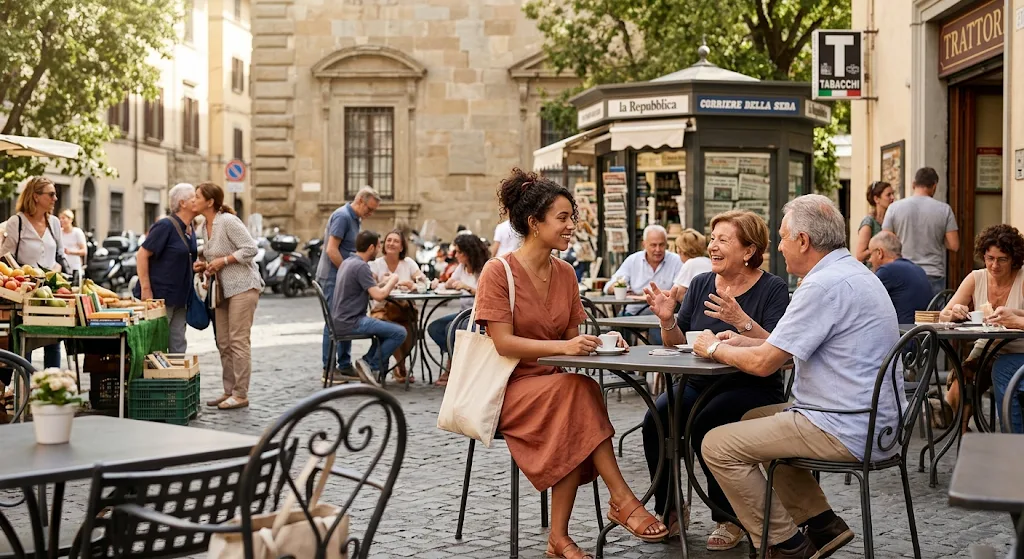
Italians are typically welcoming and sociable. It is not unusual for strangers to start chatting while waiting in a post office queue or sitting near one another on public transport.
Conversations can be lively, emotional, and fairly direct. People often express their opinions openly and enthusiastically.
Good Topics to Discuss With Italians
As in many other countries, everyday conversation can revolve around subjects such as:
- The weather
- Sports
- Art
- Food
- Drinks
Showing that you know something about the local area where you live or can use a few interesting Italian expressions may also help you connect with residents.
However, make sure you understand the subject before joining a discussion. A comment made without sufficient knowledge could lead to an unexpectedly intense debate.
Subjects to Approach With Caution
Politics and religion are generally topics to avoid unless the other person introduces them first. It is also best not to ask excessively personal questions unless you are speaking with close friends who are comfortable discussing private matters.
Italians may be relaxed and open around their established social circles but more reserved when it comes to people they do not know well. Asking intrusive questions can therefore come across as disrespectful.
Another subject best left out of ordinary conversations is the mafia. It is not necessarily a taboo topic, but it is usually irrelevant unless you are discussing films or television programmes.
Foreigners frequently bring it up when talking about Italy, so repeatedly making references to it may simply cause people to roll their eyes or lose interest.
Understanding Italian Body Language
Maintaining eye contact is an important part of communicating in Italy. When speaking with someone, try to look them in the eyes and offer a natural, gentle smile.
Personal space is generally less rigid in Italy than in many other countries, particularly during engaging conversations. Someone may casually touch your arm or shoulder while speaking, so there is usually no need to feel uncomfortable about it.
Hand gestures are another major feature of Italian communication. Italians use them frequently to express feelings, emphasise points, and communicate messages.
However, some gestures can be offensive and should be avoided unless you understand their meaning.
Examples include:
- Raising one fist while holding the bicep of the same arm with the other hand.
- Making the 'rock on' horns gesture using the thumb, index finger, and little finger.
- Making a chopping movement with one hand.
- Holding one arm horizontally across the chest with the hand stretched out.
- Flicking the fingers of one hand outward from underneath the chin.
These gestures can communicate different versions of telling someone to go away or get lost. Using them unintentionally may therefore cause offence and go against accepted Italian social etiquette.
Clothing Choices and Dress Expectations in Italy
Italy is internationally recognised as a fashion destination and is home to some of the world's most famous designer labels. Milan (Milano), in particular, is regarded as one of the leading fashion capitals globally.
Appearance and clothing are important to many Italians, who often invest in their wardrobes to achieve what is known as la bella figura – essentially, making a good impression.
In Italy, the way someone dresses can sometimes be associated with their social position or level of education. However, fitting into the local fashion culture does not mean you have to spend a fortune on luxury labels. The style and presentation of your clothes matter more than their price.
Italians generally dress more formally than people in many other European countries. For example, some men may wear a suit when going to the cinema or meeting friends for drinks.
You do not need to dress this formally for every occasion, but it is advisable to avoid clothes that are torn, dirty, or heavily creased. Sportswear and fitness clothing are also generally considered unsuitable outside sporting or exercise-related activities.
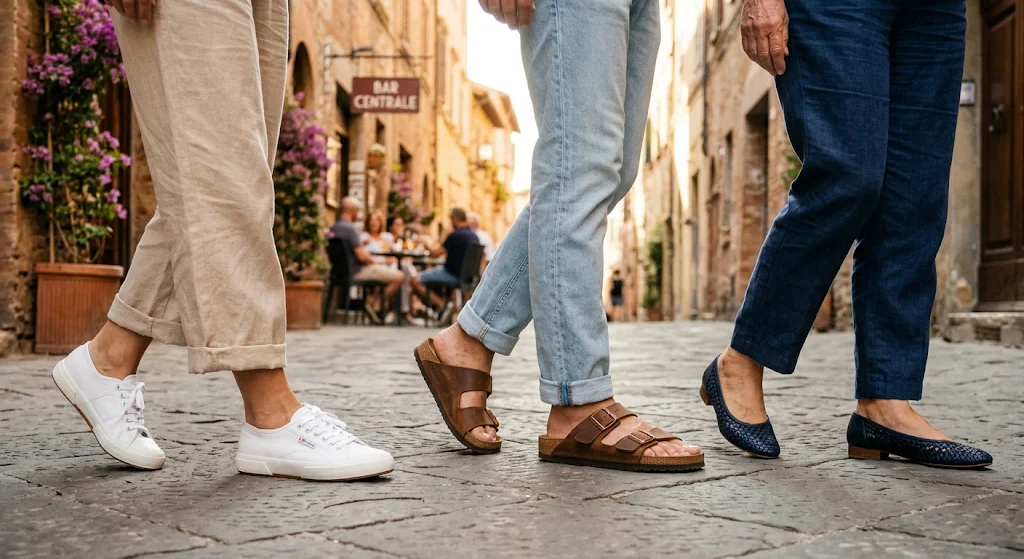
Shoes receive particular attention in Italy. Many people prefer fashionable footwear over maximum comfort, even during the summer.
What to Wear in Italian Workplaces
Professional clothing in Italy is generally conservative.
Typical business outfits include:
- Men: Dark-coloured suits, ties, and formal shoes.
- Women: Suits, dresses, or skirts and trousers paired with blouses. High heels and boots are also common choices.
Beachwear and Everyday Clothing
At Italian beaches, you will naturally see plenty of people wearing swimsuits and flip-flops. However, walking around city streets with significant amounts of exposed skin is uncommon.
Sunglasses are also extremely popular, particularly during the summer when sunlight is strongest. On hot, sunny days, it is unusual to see people walking around Italian cities without some form of sun protection.
Italian Food and Restaurant Etiquette
Food is an essential part of Italian culture and everyday life. Going to restaurants or attending dinner parties provides an excellent opportunity to practise your social etiquette.
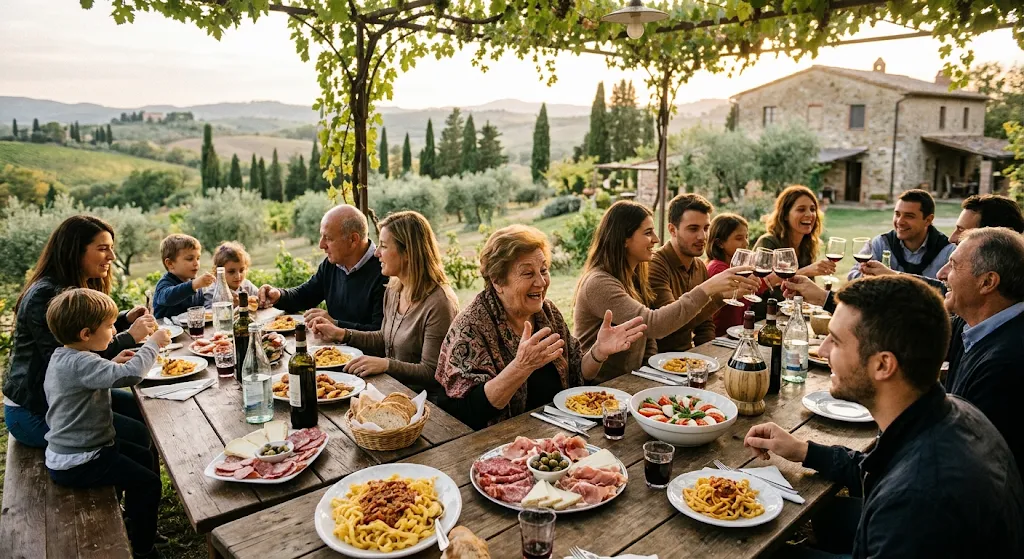
Meals with friends and colleagues are usually social occasions, with conversation receiving just as much attention as the food. As a result, gatherings can continue for several hours or longer.
Whether you are attending a dinner at someone's home or eating at a restaurant, making an effort with your appearance is generally appreciated.
Etiquette When Invited to an Italian Home for Dinner
If someone invites you to their home for dinner, arriving approximately 15–30 minutes after the stated time is generally considered acceptable.
The host usually guides the different stages of the meal. Rather than taking the initiative yourself, wait for them to:
- Show guests where to sit: Allow the host to arrange the seating.
- Give permission to begin eating: This is commonly indicated by saying buon appetito.
- Serve the drinks: Do not simply take a bottle of wine and begin pouring it yourself.
- Indicate when the meal has finished: Wait for the host to signal that the gathering around the table is over and guests can leave.
Guests are also welcome to propose a toast during Italian meals. You can raise your glass and say salute or cin cin, pronounced 'chin-chin'.
Wine and water are the drinks most commonly served with meals at home, although restaurants usually provide a wider selection.
Proper Behaviour at the Dining Table
Italians generally follow the continental dining style, holding the fork in the left hand and the knife in the right.
Some useful table manners to remember include:
- Avoid resting your elbows on the table or keeping your hands in your lap while eating.
- Pass shared dishes to the person on your left.
- Chew with your mouth closed and avoid speaking while your mouth is full.
- Take moderate portions rather than filling your plate with too much food at once.
- Use a knife when handling cheese and cutting fruit.
- When you finish eating, place your fork and knife side by side on your plate.
- Use your napkin to gently clean your mouth after eating.
- When eating pasta, twirl it around your fork and eat it without slurping.
- In a restaurant, politely attract the waiter's attention with a gesture and say il conto, per favore (the bill, please).
Bread is frequently served alongside Italian meals. It is often used to soak up the remaining sauce on the plate at the end of a meal, a practice commonly known as fare la scarpetta.
Some people prefer eating bread with a knife and fork, but using your hands is also generally acceptable and unlikely to attract unwanted attention.
Making Friends and Socialising in Italy
Moving to Italy can open up plenty of opportunities to meet people and develop new friendships.
Social activities are varied and may include:
- Going out to restaurants and cafés.
- Watching films at the cinema.
- Attending concerts.
- Visiting art galleries and museums.
- Playing or watching sporting events.
- Meeting friends at a bar for drinks and conversation.
Italy also hosts a wide range of festivals, cultural celebrations, and public events throughout the year. Check the local events calendar for your region to find activities happening near you.
Although Italians appreciate good wine and quality beer, their alcohol consumption is generally more moderate than in several other European countries.
In fact, Italy has the third-lowest alcohol consumption rate in the EU, ranking behind only Greece and Sweden.
Dating and Romantic Relationships in Italy
Italy is often described as one of the world's most romantic destinations. Although the image of someone singing beneath their partner's window in the moonlight may be more familiar from films, dating and romance remain an interesting part of Italian social life.
Popular places for dates include restaurants, cafés, and cinemas.
When relationships become more serious, Italian couples are generally comfortable showing affection in public. Kissing, hugging, and holding hands are common ways of expressing affection.
Online dating has also made it easier for international residents to meet potential partners in Italy.
Some everyday social expectations apply to dating as well. For example, dressing appropriately for a date is appreciated, while the relaxed approach to punctuality should not be taken too far.
Family Life and Relationships
Family occupies a central position in Italian society. Many young adults continue living with their parents, and it is common for extended family members to live relatively close to one another.
Interestingly, despite the importance of traditional family relationships, Italy has the lowest marriage rate in Europe. In 2020, the country recorded just 1.6 marriages per 1,000 people.
LGBTQIA+ Relationships and Rights
Italy continues to lag behind parts of western Europe in terms of LGBTQIA+ rights and public attitudes.
According to Equaldex's LGBT Equality Index, Italy ranks 49th worldwide.
Same-sex couples have been legally allowed to enter into civil unions since 2016, although same-sex marriage is not yet legal.
Celebrations and Party Customs in Italy
Italy has a busy calendar of national holidays, religious occasions, and local celebrations throughout the year.
Some of the main national public holidays include:
- Liberation Day (Festa della Liberazione): Celebrated on 25 April.
- Republic Day (Festa della Repubblica Italiana): Observed on 2 June.
Both occasions are commonly marked by large public gatherings, celebrations, and parades.
There are also numerous regional and local festivals, offering opportunities to experience the traditions of the area where you live.
Religious Festivals and the Italian Christmas Season
Catholic Christian holidays are widely observed throughout Italy. Major celebrations include Christmas, Easter, and All Saints' Day, which falls on 1 November.
The Christmas period (Natale) officially begins with the Feast of the Immaculate Conception on 8 December, when many families traditionally put up their Christmas trees. The festive season continues until Epiphany (Epifania) on 6 January.
During this period, towns and cities are decorated with colourful street lights, Christmas markets, and nativity displays.
As with many Italian celebrations, family gatherings and food are central to Christmas traditions.
Families commonly meet for a large meal and exchange presents on 24 December. Others prefer to celebrate with their main gift exchange on the morning of 25 December, a practice particularly common in northern Italy.
Santa Claus is known as Babbo Natale in Italy. However, he is not the only figure associated with giving presents. Santa Lucia and Befana are also part of the country's gift-giving traditions.
Befana, in particular, visits children on Epiphany, bringing another collection of smaller gifts.
Birthday Celebrations in Italy
Italian birthday customs are similar to those in many other countries. Celebrations often involve cake, presents, and sometimes a special meal or party.
However, there is one tradition worth knowing: the person celebrating their birthday usually pays for the gathering. This is considered a way of thanking friends and family for coming to celebrate with them.
Birthday cards are not especially common in Italy. Remembering the occasion and showing up to celebrate is often more important.
Children's birthday parties are also popular. Some parents prefer hiring a community hall or another public venue rather than hosting the celebration at home. Guests are generally expected to bring presents for the birthday child.
An especially important birthday is the 18th, when a person officially reaches adulthood. Celebrations for this milestone are often much bigger than those held for earlier birthdays.
To wish someone a happy birthday in Italian, you can say:
- Tanti Auguri
- Buon Compleanno
Giving Presents and Gift-Giving Customs
When invited to someone's home in Italy, bringing a small present for the host is considered good manners.
It does not need to be anything expensive. Suitable choices include:
- A bottle of wine.
- Chocolates.
- Flowers.
Italians often take great care when wrapping gifts and may use elaborate decorative paper.
However, black and purple wrapping paper should generally be avoided because these colours are traditionally associated with funerals and bad luck.
Exchanging or giving personal gifts in the workplace is not a common Italian custom.
When someone gives you a present, it is normal to open it immediately in front of them. This gives you an opportunity to express your appreciation and thank the giver straight away.
Professional Behaviour and Business Culture in Italy
Italian business culture combines a strong sense of hierarchy with an emphasis on personal relationships.
Most organisations have clearly defined management structures, and employees are expected to show respect towards senior colleagues and people in positions of authority.
However, business meetings and decision-making processes can be relatively informal and less structured.
During discussions, openly expressing disagreement is generally acceptable. Participants may also interrupt one another frequently, a communication habit that might be considered impolite in some other countries.
Trust is particularly important in Italian business relationships. Companies often prefer working with organisations and individuals they already know and have established relationships with.
Unlike social gatherings, where punctuality may be more flexible, arriving on time is an important part of professional etiquette. Make sure you are punctual for job interviews, meetings, and other work-related appointments.
Business lunches are also common in Italy, and expectations around timing can be more relaxed in these settings.
Shopping Habits and Customer Service in Italy
Shopping is a popular activity throughout Italy. Cities and towns have lively commercial streets featuring everything from major international designer outlets to small independent grocery shops.
The quality and style of customer service can differ significantly depending on the location, type of business, and size of the establishment.
When visiting a small, family-owned shop, you can often expect friendly staff who are happy to start a conversation and get to know their customers.
Italian customer service generally reflects the country's direct communication style. Interactions may be straightforward and less formal, without excessive politeness or unnecessary conversation. Visitors sometimes mistake this directness for rudeness, even when no offence is intended.
Nevertheless, customer satisfaction is taken seriously across Italy's service industry. Around 83% of businesses actively monitor customer satisfaction ratings.
Customer behaviour can sometimes be unpredictable, particularly when people are waiting in queues for services.
To make waiting arrangements more organised, some larger shops have introduced ticket-based systems. These help manage the queue and ensure customers are attended to in the correct order.
Tipping Practices in Italy
Italy does not have strict or universal rules about tipping. However, leaving a small amount as a gesture of appreciation is common in many situations.
The usual approach is to give a modest cash tip at your discretion, either after receiving the service or when settling the bill.
The following amounts provide a general idea of what you might leave:
- Restaurants and bars: Up to 10% of the total bill.
- Café baristas: Round the amount up to the nearest euro.
- Taxi drivers: Round the fare up to the nearest €5–10.
- Tour guides: Approximately €5–10 per person.
- Hotel porters: Around €1 per bag.
- Housekeepers: Approximately €1–2 per day, with more for larger rooms or spaces.
One important point to remember is to give tips to the employees who provide the service rather than to the business owner.
Cultural Differences Across Italy's Regions
Italy is a relatively young unified country, having officially come together in 1861. As a result, regional identities remain deeply rooted in everyday life.
Each of the country's regions enjoys a degree of political autonomy and has its own history, dialect, traditions, and interpretations of Italian social etiquette.
This means that customs, cultural expectations, and everyday behaviour can vary considerably depending on where you live.
In some areas, people may feel a stronger connection to their regional identity than to their identity as Italians as a whole. This is particularly noticeable in places such as Veneto, Lombardy, and the islands of Sicily and Sardinia.
If you are planning to move to Italy, it is worth researching the specific region, city, or town where you intend to settle. Understanding local customs will help you adjust more comfortably, build relationships, and become part of your new community.