A Guide to Primary Schools in Luxembourg
Learn about primary schools in Luxembourg, including the different school options available, how to apply, tuition fees and other essential details.

Understanding Luxembourg’s education system can initially be challenging, particularly when it comes to primary schooling. The country’s multilingual environment can make the process even more confusing for expatriate families trying to find the right school for their children.
To help make the process easier and support informed decisions, this article covers the following topics:
The Primary Education System in Luxembourg
Primary education in Luxembourg takes between eight and nine years and is organized into four learning cycles, or grade levels, based on a child's age:
- Cycle 1 (Spillschoul): Ages 3 to 5
- Cycle 2: Ages 6 to 7
- Cycle 3: Ages 8 to 9
- Cycle 4: Ages 10 to 11
Cycle 1 corresponds to preschool education and usually lasts three years. Its first year, called précoce, is optional and open to children aged three. However, education becomes compulsory in Luxembourg from the age of four. Luxembourgish is the main language used during Cycle 1, while French and German are introduced in Cycles 2 to 4.
Generally, each learning cycle lasts two academic years. However, this period can range from one to three years depending on how quickly a student develops the required foundational skills (socles de compétences).
Children in Luxembourg can attend public, private or international primary schools. As of 2020, most pupils (89%) attended public schools. Among these students, 98% followed the Luxembourg national curriculum, while 2% studied an international curriculum. Of the 11% attending private schools, most (98%) were enrolled in alternative educational programmes rather than the national Luxembourg curriculum.
Primary school pupils in Luxembourg receive 924 hours of compulsory teaching annually, exceeding the OECD average of 804 hours. By comparison, lower secondary school students receive 845 hours, below the OECD average of 916 hours.
Public Primary Schools in Luxembourg
Luxembourg has 156 public primary schools, organized into 15 local education directorates (directions de l’enseignement fondamental). These schools are administered by the state and municipalities. Each directorate has an inspector responsible for overseeing teaching activities and coordinating professional teams.
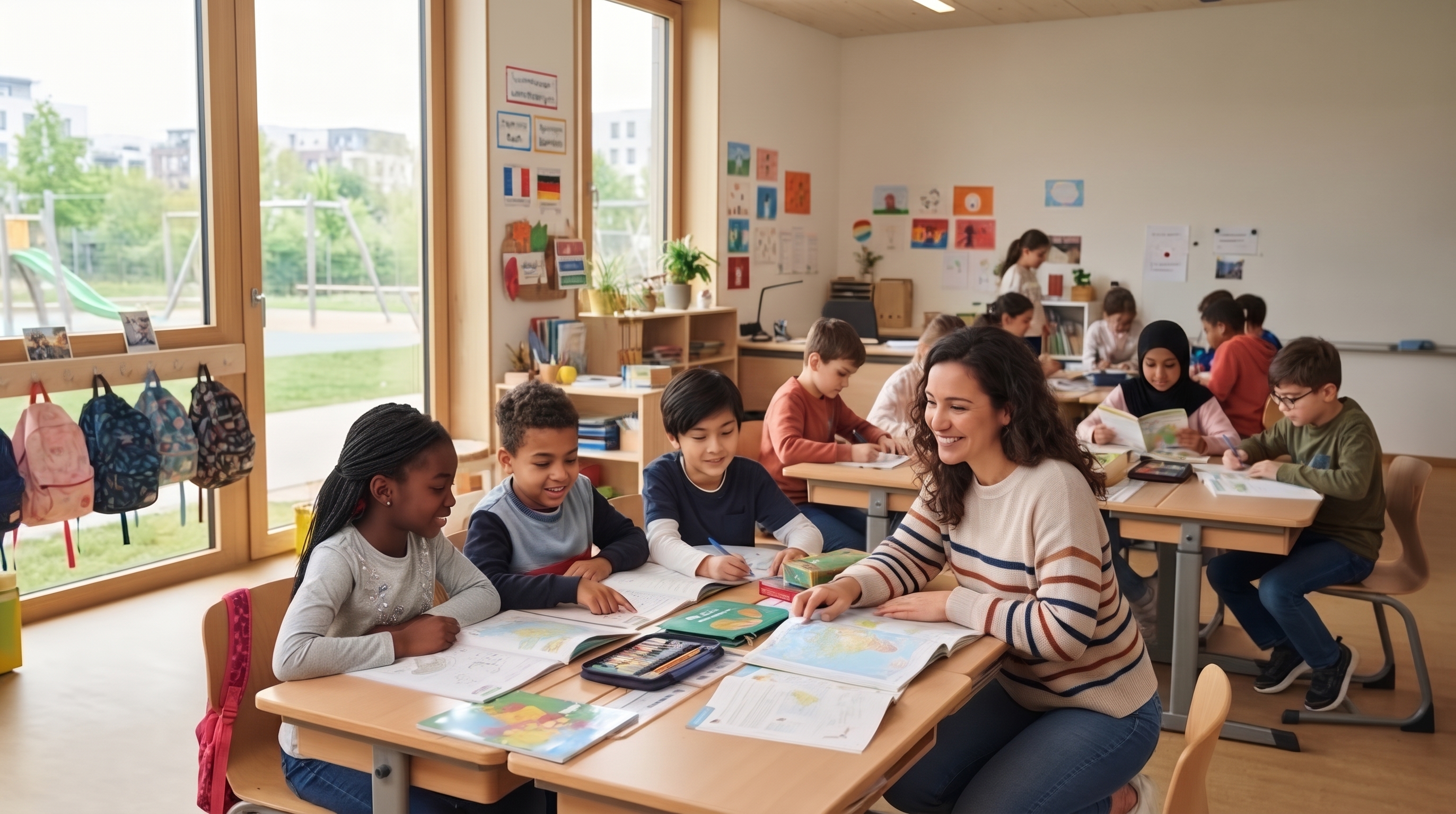
Public primary schools receive funding from the Ministry of Education, Children and Youth (Ministère de l’Éducation Nationale, de l’Enfance et de la Jeunesse, or MENJE). As a result, attendance is free.
Most public schools follow the same curriculum, although three provide different educational approaches:
- Eis Schoul (Kirchberg): Follows inclusive education principles, welcoming children with different needs and backgrounds. Pupils learn at their own pace and are encouraged to develop independence, responsibility, social interaction skills and the ability to express their views while respecting others.
- Jean-Jaurès (Esch-sur-Alzette): Operates as a continuous-day school, where learning periods, leisure time and rest are integrated throughout the day. Learning and everyday life are treated as closely connected parts of school life.
- Villa Mirabella (Wiltz): Also follows a continuous-day model, with a structured Monday-to-Friday timetable. This includes 27 hours of free school lessons and 13 hours of paid activities.
Public International Schools
Luxembourg has six public international schools that follow the European school system and curriculum. At primary level, they provide French-, English- and German-speaking sections. These schools are free and accessible to all students:
- Differdange et Esch-sur-Alzette (EIDE): Provides French, English and German sections from primary school.
- Gaston Thorn (EIGT): Offers French, German and English sections at primary level.
- International School Michel Lucius: Provides an English-language curriculum at primary level.
- Lënster Lycée International School: Offers French, English and German sections from preschool.
- Lycée Edward Steichen: Provides French, English and German sections from preschool.
- Mersch Anne Beffort (EIMAB): Offers French and English sections from primary school, with a German section available from secondary school.
- Mondorf-les-Bains: Provides French and English sections from primary school.
The Schedule in Public Primary Schools
Public primary schools generally operate on a timetable consisting of three full days and two half days.
Full school days are Monday, Wednesday and Friday, from 08:00 to 16:00, with a two-hour lunch break. The half days are Tuesday and Thursday, from 08:00 to 11:45.
Classes have an average of 20 students.
The academic year in Luxembourg usually begins in mid-September and finishes around the middle of July. School holidays and public holidays during the year include:
- October/November (All Saints' Day holidays): One week
- December/January (Christmas holidays): Two weeks
- February (Carnival/Winter holidays): One week
- March/April (Easter holidays): Two weeks
- 1 May: Public holiday
- 9 May: Europe Day public holiday
- May/June (Ascension Day): Public holiday
- May/June (Whit Monday): Public holiday
- May/June (Pentecost holidays): One week
- 23 June: Public holiday celebrating the birthday of HRH the Grand Duke
- July/August (Summer holidays): Two months
The Curriculum in Public Primary Schools
In Cycle 1, public primary education places particular emphasis on children's social development. Different learning activities give pupils opportunities to interact meaningfully with their classmates and teachers.
According to the Ministry of Education, the main areas of learning include psychomotor development, creative expression, community life, culture and language awareness.
In Cycles 2 to 4, children study literacy, German, French and Luxembourgish, alongside mathematics and science. Culture, health and music are also included in the programme. Physical education is compulsory, although the number of hours allocated to it may differ.
International children arriving in Luxembourg at the age of four or five enter Cycle 1 directly, where they learn Luxembourgish.
From Cycle 2 onwards, they join a regular class, known as a classe d’attache or linkage class, while also attending intensive language lessons (cours d’accueil or reception courses) or additional support lessons (cours d’appui). These classes provide instruction in German and/or French.
At the end of every cycle, pupils are expected to demonstrate that they have acquired the required foundational skills before moving to the next level. Teachers evaluate their progress through tests, assignments and observations.
At the end of each school term, teachers also hold individual meetings (entretien individuel) with parents to discuss the child's development and what should happen next.
Parents receive two school reports each year to follow their child's progress:
- Intermediate report (bilan intermédiaire): Issued at the end of each school term.
- End-of-cycle review (bilan de fin de cycle): Provided when the child completes a learning cycle.
Further details about these learning areas and assessment procedures are available on the Ministry of National Education, Children and Youth website.
The Advantages and Disadvantages of Public Schools
Attending a public primary school in Luxembourg offers several benefits. These schools are free and widely available, making it more likely that a school will be located close to the child's home. This can make daily arrangements easier for parents and help children develop a sense of belonging within their local community.
Public schools also bring together pupils from different social and economic backgrounds. This diversity can contribute positively to children's cultural and social development.
However, public schools may have fewer resources because they depend on state funding, which can be limited. A shortage of teachers and Luxembourg's below-average performance in early childhood education compared with other European countries may also concern some parents.
Applying to Public Primary Schools
When moving to Luxembourg, families must register with the commune where they live. Once this registration is completed, the municipality automatically enrols the child in the public school assigned to their residential area.
School admissions begin in August, so enrolment generally takes place in March or April of the same year.
Parents should receive a letter from the communal administration by 15 April to begin the process. The letter explains when the child must start compulsory education and provides information about registration at the school assigned to the commune. It also includes an enrolment form.
If the letter and form have not arrived by 15 April, parents should contact the communal administration to request them.
To complete the registration, parents must visit the commune's administration or education department and provide the following documents:
- The family record book
- The child's birth certificate
- The enrolment form
After submitting these documents, parents receive an acceptance letter containing relevant details about the assigned school, including its timetable and term dates.
Families who move to Luxembourg during the school year should contact their local education department directly. The department will explain how to enrol the child for the following quarter.
Private Primary Schools in Luxembourg
Private primary schools in Luxembourg offer different curricula and teach in several languages.
Some follow the same curriculum as public schools, such as Notre-Dame Sainte-Sophie in Neudorf-Weimershof. Others use alternative educational approaches, including Montessori and Waldorf methods, and receive state subsidies.
There are also private international schools that provide different curricula and receive funding from either the state or the European Schools organization.
Montessori and Waldorf Schools
Luxembourg has three private schools that use Montessori and Waldorf educational approaches. Although they operate independently under these teaching methods, they remain supervised by the country's regions and must comply with national education legislation. They also receive state subsidies.
These schools are:
- Ecole Maria Montessori: French and German – Montessori
- Fräi-ëffentlech Waldorfschoul Lëtzebuerg: French – Waldorf
- Montessori à Hobscheid: Luxembourgish, French and German – Montessori
The Montessori approach was developed in the early twentieth century by Dr. Maria Montessori. Her philosophy was based on the belief that children's independence is central to their education.
At Ecole Maria Montessori and Montessori à Hobscheid, teachers therefore promote independent activities and practical learning experiences. They also create an environment where children can build social skills, develop a passion for learning, express creativity and gain confidence.
The Waldorf approach, created in 1919 by philosopher Rudolf Steiner, focuses on three aspects of development: the head (thinking), the heart (feeling) and the hands (doing). It allows children to develop according to their natural rhythms.
Consequently, the Waldorf curriculum, as taught at Fräi-ëffentlech Waldorfschoul Lëtzebuerg, brings together academic subjects, artistic activities and practical skills.
International Schools in Luxembourg
Some international schools in Luxembourg receive government subsidies, helping to reduce the costs for parents. However, fees differ considerably between schools, so families should consult individual school websites for accurate information.

For example, in 2022, annual preschool fees started at €10,550 at Over The Rainbow (OTR) and €17,015 at the International School of Luxembourg (ISL). Parents should also consider that many schools charge a non-refundable application fee.
These schools follow curricula that differ from those used in Luxembourg's public primary schools. Parents therefore need to research the available options carefully to identify the most appropriate school for their child.
The following international schools offer different curricula and receive state subsidies:
- Charlemagne: French
- International School of Luxembourg (ISL): German and French
- Lycée Français de Luxembourg: French
- Over the Rainbow (OTR): English and French
- Scuola Materna Cattolica Internazionale: Italian-English, English-French and Italian-French
- St. George’s International School Luxembourg: English-only or French-English bilingual programme
In addition to these schools, Luxembourg has two private international schools established, financed and operated by the European Schools organization. They are managed by the European Union and European Commission.
These are:
- European School Luxembourg 1 (ESL1): Located in Kirchberg.
- European School Luxembourg 2 (ESL2): Located in Mamer.
Both schools offer English, French and German sections at preschool and primary levels. ESL2 also provides sections in Czech, Danish, Greek, Italian and Hungarian.
The Advantages and Disadvantages of International Schools
Although local schools in Luxembourg provide good facilities and educational opportunities, some parents choose international schools because they generally offer a wider selection of languages, sports and extracurricular activities.
They also allow children to continue learning in their native language, which may make it easier for them to adapt to their new surroundings.
International schools also provide a more multicultural environment because they are designed to serve students from different countries. This diversity can support children's overall development.
Private schools, in contrast, often have a less diverse environment, with pupils coming from similar social and economic backgrounds.
However, international school fees can remain expensive even when government subsidies are available. This may place them beyond the financial reach of some families.