Understanding Healthcare in Portugal: A Guide for Expats
A practical guide to healthcare in Portugal for expats, explaining how the public and private systems work, who is eligible, how to register, what medical care costs, and how to access healthcare as a newcomer.

Portugal remains a popular choice for people moving abroad, whether they are looking for a place to live, work, study, or enjoy retirement in a warm and welcoming environment. If you are planning to relocate to Portugal, it is important to understand how the country's healthcare system operates before your move so that you know how to access medical services and protect yourself if you need treatment.
This guide explains how Portugal's healthcare system works, who is eligible for public medical services, when private insurance may be useful, and what steps to take when you first arrive and as you establish residency.
The information is intended for general guidance and should not be treated as medical, legal, or insurance advice. Always confirm the latest requirements with your local health centre, SNS24, or insurance provider.
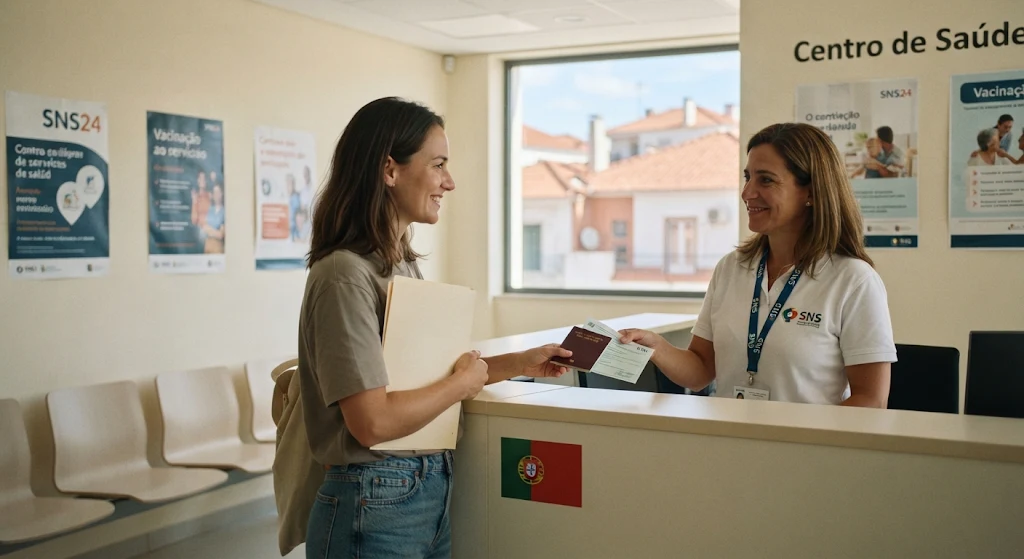
Essential Things to Know About Healthcare in Portugal
Here are some quick answers to common questions about accessing healthcare in Portugal:
- Who is eligible for public healthcare? Residents who meet the requirements can generally access public medical services through the Serviço Nacional de Saúde (SNS), Portugal's National Health Service. Temporary visitors may receive medically necessary treatment, but this does not give them the same access as registered residents.
- What is a número de utente? This is your SNS user identification number. It is used when registering for public healthcare, arranging appointments, and linking your medical records to the national system.
- When might private health insurance be useful? Private cover can be helpful from the beginning of your stay if your registration documents are still being processed, if you want quicker access to specialists, or if you need wider coverage for dental, optical, or mental health services.
- Will you still have to pay for healthcare? Yes. You may have additional expenses for prescriptions, certain emergency situations, private consultations, dental and optical treatment, and some mental health services.
- What should you arrange first? Review the requirements for your visa, obtain your NIF, confirm whether you need social security registration, prepare proof of your Portuguese address, and register with your local health centre as soon as possible.
How Portugal's Healthcare System Works for Expats
The healthcare system in Portugal can be understood through three main components:
- Public healthcare provided through the SNS.
- Medical services offered by private hospitals and clinics.
- Private health insurance, which can make it easier to access private medical providers.
Public Medical Services Through the SNS
On mainland Portugal, public healthcare is organised through the Serviço Nacional de Saúde (SNS), also known as the National Health Service.
For most people, the starting point for routine medical treatment is a local centro de saúde (health centre) or Unidade de Saúde Familiar (USF), meaning Family Health Unit. These facilities generally handle primary healthcare, referrals to specialists, prescriptions, and continuing medical care.
This structure is important because the public system generally expects patients to begin with primary healthcare rather than going directly to a specialist.
The healthcare arrangements in Madeira and the Azores are different because these islands operate their own regional health systems. If you are moving to either location, make sure you check the relevant local procedures instead of assuming that the rules used on mainland Portugal will apply.
Private Healthcare and Why Expats Often Combine Both Systems
Many people living in Portugal do not treat public and private healthcare as mutually exclusive options. Instead, they use the SNS for regular medical needs and ongoing treatment while turning to private clinics or hospitals when they want quicker appointments, more direct specialist access, or a greater chance of finding English-speaking medical professionals.
This approach is particularly common in Lisbon, Porto, and the Algarve. Well-known private healthcare providers in these areas include:
- CUF.
- Hospital da Luz.
- Lusíadas.
Dental treatment, eye care, and certain mental health services are also reasons why some expats prefer private providers. Access to these services through the public system may be more limited or involve longer waiting times.
Who Can Access Public Healthcare in Portugal, and When?
Eligibility for healthcare in Portugal is influenced more by your residency status and stage of registration than simply by whether you are an expat.

Residents, Employees, Retirees, and Family Members
People who qualify as residents can generally use the SNS once their registration has been completed.
This may include:
- Employees and other eligible workers.
- Eligible family members and dependants.
- Retirees.
The exact registration process depends on your residence status, whether you can provide proof of your Portuguese address, and whether you need to present details from Segurança Social (Social Security) or an S1 form.
One important point to understand is that receiving a número de utente does not automatically mean that all your healthcare expenses will be covered.
According to the healthcare information for migrants published on gov.pt, having an SNS user number alone may not be sufficient to activate full public healthcare coverage. Your identification documents, Portuguese address, NIF, and valid residency information may also need to be connected to your record.
Before assuming that your registration is fully active, check the requirements with your local health centre.
Visitors from the EU, EEA, Switzerland, and the UK
If you are visiting Portugal temporarily and have a valid European Health Insurance Card (EHIC) or Global Health Insurance Card (GHIC), you may be entitled to medically necessary healthcare during your stay.
However, this is not the same as having full access as a resident. Full resident access is connected to living in Portugal and completing the appropriate registration procedures.
EHIC and GHIC cards are intended for temporary visits rather than long-term relocation. If you are moving to Portugal permanently or for an extended period, you should not depend on either card as your long-term healthcare arrangement.
What to Do While Your Registration Is Still Being Processed
The first 90 days after arriving in Portugal can involve several administrative processes happening at different speeds. Your visa, proof of address, NIF, and local healthcare registration may not all be ready at the same time.
If you have not completed your paperwork, contact SNS24 first. Explain your circumstances and ask which healthcare route applies to you before going directly to an urgent care facility.
If you need medical protection immediately, want faster appointments, or prefer wider access while your residency arrangements are being finalised, you may want to compare private insurance options.
Expatica's health insurance quotes page provides a way to compare:
- Cigna Health Insurance.
- Allianz Health Insurance.
When reviewing policies, do not focus only on the advertised premium. Pay attention to:
- When the insurance cover begins.
- Waiting periods before certain treatments are covered.
- Whether direct billing is available.
- Policy exclusions.
- Age-related eligibility conditions.
- Whether the policy can be used in other countries.
Registering for Public Healthcare and Obtaining Your Número de Utente
Your número de utente is your identification number within Portugal's public healthcare system. You will use it when accessing services and managing your SNS healthcare record.
Documents and Steps Normally Required for Registration
The registration process is generally easier when completed in the following order:
- Confirm your immigration arrangements. Review the requirements that apply to your situation using Expatica's Portugal visas and immigration guide.
- Obtain your NIF. If your employment or other circumstances require it, also arrange your NISS or the relevant Social Security registration.
- Prepare your identification and residency documents. Gather your passport or national ID, residence information, and evidence of your permanent address in Portugal.
- Visit a local health centre. Go to your nearest centro de saúde or USF and request registration with the public healthcare system.
- Ask about your user number. If you have not yet received a número de utente, find out whether it can be issued as part of the registration process.
According to the official healthcare registration information on gov.pt, foreign nationals are generally asked to provide:
- Residence authorisation.
- Proof of a permanent address in Portugal.
- A civil identification number.
- Their NIF.
Once your registration is complete, you can arrange access to the SNS24 online portal or mobile application. This makes it easier to manage appointments and access healthcare records digitally.
What Happens If Your Documents Are Missing or Delayed?
If your residence permit application is still being processed, your local health centre may request additional evidence or explain whether a temporary registration procedure is available.
The practical requirements may differ, so confirm the latest instructions directly with:
- Your local health centre.
- SNS24.
- The official gov.pt information on obtaining a NIF.
- The official gov.pt information on NISS and Social Security registration.
You may also discover that a family doctor has not been assigned to you immediately. This does not necessarily mean that you are unable to access public healthcare, but it may make routine appointments and specialist referrals more difficult to arrange.
If you are uncertain about which service to contact, SNS24 can help direct you to an appropriate healthcare provider for situations that are not immediately life-threatening.
Managing Money Internationally with a Wise Account
Are you already living in Portugal or preparing to move there? Managing money across different countries does not have to be complicated.
A Wise account allows you to hold more than 40 currencies and use a Wise debit card in over 150 countries. Whether you need to make payments while abroad, receive money, or send funds to family in your home country, Wise can help simplify international money management.
Go to the Wise website.
When Should Expats Consider Private Health Insurance?
Private health insurance is best understood as a practical way to improve access to medical services. It is not a compulsory expense for every person moving to Portugal.
Situations Where Public Healthcare May Be Sufficient
The SNS may meet your needs if you are an established resident, generally require routine medical attention, can manage communication in Portuguese or have suitable language support, and do not need immediate access to specialists.
It can be a suitable option if you are comfortable starting with your local health centre and following the usual referral process when specialist treatment is necessary.
The main disadvantages may involve waiting times and flexibility. Some specialist services can have longer queues, and the quality of your experience may depend on your region, the healthcare provider, and the availability of English-speaking staff nearby.
Circumstances Where Private Insurance May Be a Better Choice
Private health insurance may be more suitable if you value:
- Faster access to medical appointments.
- A wider choice of hospitals and clinics.
- Easier access to English-speaking healthcare professionals.
- More extensive dental and optical benefits.
- Better coverage for certain mental health services.
It may also be worth considering if you are moving with family, retiring in Portugal, or expecting to need specialist consultations regularly.
Comparing Public Healthcare with Private Insurance
Public healthcare through the SNS:
- Where treatment begins: Usually at a local health centre or USF.
- Appointment speed: Non-urgent treatment and specialist appointments may take longer.
- Access to English-speaking professionals: Availability may be better in major cities but can be limited elsewhere.
- Dental and optical services: Coverage is limited in many situations.
- Choice of providers: Access is generally guided by referrals and the public healthcare structure.
Private healthcare with insurance:
- Where treatment begins: Through the insurer's provider network or a private clinic.
- Appointment speed: Routine specialist appointments are often available more quickly.
- Access to English-speaking professionals: Usually easier to find within private healthcare networks.
- Dental and optical services: Benefits may be more extensive, depending on the policy.
- Choice of providers: The range of options is often wider, although it depends on the insurance plan.
Comparing Cigna and Allianz Health Insurance for Portugal
Both Cigna Health Insurance and Allianz Health Insurance may be worth considering if you are an expat living in Portugal. However, their suitability depends on your personal circumstances and the type of cover you need.
Cigna may be attractive if you prefer an international insurance arrangement and want to consider portability between countries. Allianz may appeal to people who want to compare a large international insurer with established options for expatriates.
Rather than focusing on which company is generally better, consider whether the specific policy fits your relocation plans and healthcare requirements.
Request current quotations from both providers and compare the following details:
- Deductibles.
- Co-payments.
- Direct billing arrangements.
- Waiting periods.
- Exclusions and limitations.
- Optional maternity or dental benefits.
- Age-related conditions or restrictions.
For a more straightforward comparison, consult Expatica's guide to getting health insurance in Portugal in 2026 and its health insurance quotes page.
Healthcare Expenses Expats Should Prepare For
Portugal's public healthcare system is relatively affordable compared with many international alternatives. However, this does not mean that every medical service is completely free.
Everyday Medical Treatment, Prescriptions, and Additional Expenses
Even when you qualify for public healthcare, some costs may still fall to you.
Possible expenses include:
- Prescription medicines.
- Certain private medical consultations.
- Dental treatment.
- Glasses and contact lenses.
- Mental health services that are not covered by the SNS.
The cost of visiting a private general practitioner or specialist can also differ depending on the city, clinic, and whether your insurance provider has a direct-billing agreement with the medical facility.
If you need to check medicine prices, use the official medicine price search tool provided by Infarmed rather than depending on estimates shared in online forums.
If you have private insurance, read the policy carefully. Reimbursement arrangements, exclusions, and co-payment requirements can vary from one plan to another.
Emergency Treatment, Specialist Referrals, and Avoiding Unexpected Bills
If someone is experiencing a life-threatening emergency, call 112.
For health problems that are urgent but not life-threatening, contact SNS24 on 808 24 24 24 first. Its triage and referral service can help you identify the appropriate healthcare service.
One common mistake is going directly to a hospital emergency department for a condition that should first be assessed by SNS24 or a primary healthcare provider.
This is important because certain emergency department charges may still apply if you attend without the appropriate referral and are not admitted to hospital.
What you should do:
- Contact SNS24 first when you have an urgent health problem that is not life-threatening.
- Keep your SNS user number and identification documents accessible.
- Ask whether obtaining a referral will affect the cost of treatment or the healthcare route you should follow.
What you should avoid
- Assuming that every visit to a hospital emergency department is free.
- Expecting public and private hospitals to charge patients in the same way.
- Overlooking specialist referral requirements if you want your treatment to be covered through the SNS.
Frequently Asked Questions About Healthcare in Portugal for Expats
Can Foreign Residents Access Free Healthcare in Portugal?
Expats who qualify as residents can generally use public healthcare through the SNS. However, describing the system as entirely free can be misleading.
Public healthcare receives substantial government support, but patients may still have to pay for prescriptions, certain emergency situations, private treatment, and services such as dental and optical care.
Is Private Health Insurance Compulsory for Expats in Portugal?
No. Not every expat needs private health insurance.
Some people rely entirely on the SNS, while others choose private policies because they want quicker appointments, more extensive benefits, or easier access to English-speaking healthcare professionals.
If your public healthcare registration is still being processed or you want private medical access from the day you arrive, compare providers such as Cigna Health Insurance and Allianz Health Insurance before choosing a policy.
How Can You Obtain an SNS Number in Portugal?
You can generally receive your número de utente by registering with a public healthcare unit or your local health centre and presenting the required documents.
Check the latest registration procedure on gov.pt and contact your own health centre to confirm exactly which documents it expects you to bring.
Can You Use Portugal's Healthcare Services Before Receiving Your Residence Permit?
In some circumstances, you may be able to access healthcare before your residence permit has been issued. However, eligibility depends on your individual situation and the documents available to you.
Do not automatically assume that you already qualify for the same coverage as a fully registered resident. Contact SNS24, gov.pt, or your local health centre to confirm which process applies to you.
Is It Easy to Find English-Speaking Doctors in Portugal?
Finding English-speaking doctors is generally easier in Lisbon, Porto, and the Algarve, as well as within private hospital networks.
In smaller towns and certain parts of the public healthcare system, English-speaking professionals may be less readily available. It is therefore useful to check the language options offered by a healthcare provider before registering or arranging an appointment.
Helpful Healthcare Resources for Portugal
Resources checked on 19 July 2026.
The following services and guides can help you understand the healthcare system, obtain assistance, and complete the necessary registration procedures:
- SNS24 – Official Health Line and Digital Services: Access Portugal's official health support line and online healthcare services.
- gov.pt – Healthcare Registration: Guidance on who can register for public healthcare and the steps involved.
- Expatica – Emergency Services in Portugal: Numbers and Helplines: A more detailed guide to emergency contact numbers and support services in Portugal.